Why Momenta Works: The Psychology Behind Daily Rituals for Mothers
The research and design thinking behind a wellness app built specifically for mothers - not wellness enthusiasts, not meditators, not productivity hackers. Mothers.
Posted by Alfred Prah on April 15, 2026 · 15 mins read
Most wellness apps are built for a generic user. They assume you have 20 minutes, a quiet room, and the mental bandwidth to "set an intention." Mothers have none of these things. They have a baby on one hip, a toddler asking for a snack, and about 90 seconds before someone needs something.Momenta was designed around this reality. Every feature in the app maps to a specific psychological principle, and every interaction was designed to fit into the fractured, unpredictable rhythm of motherhood. Here is the thinking behind each piece.
The Mood Check-In: Emotional Granularity
When you open Momenta, the first thing you see is a mood check-in. Six options: Overwhelmed, Exhausted, Lonely, Doing Okay, Happy, Need Strength. You tap one (or several), and you move on. It takes about three seconds.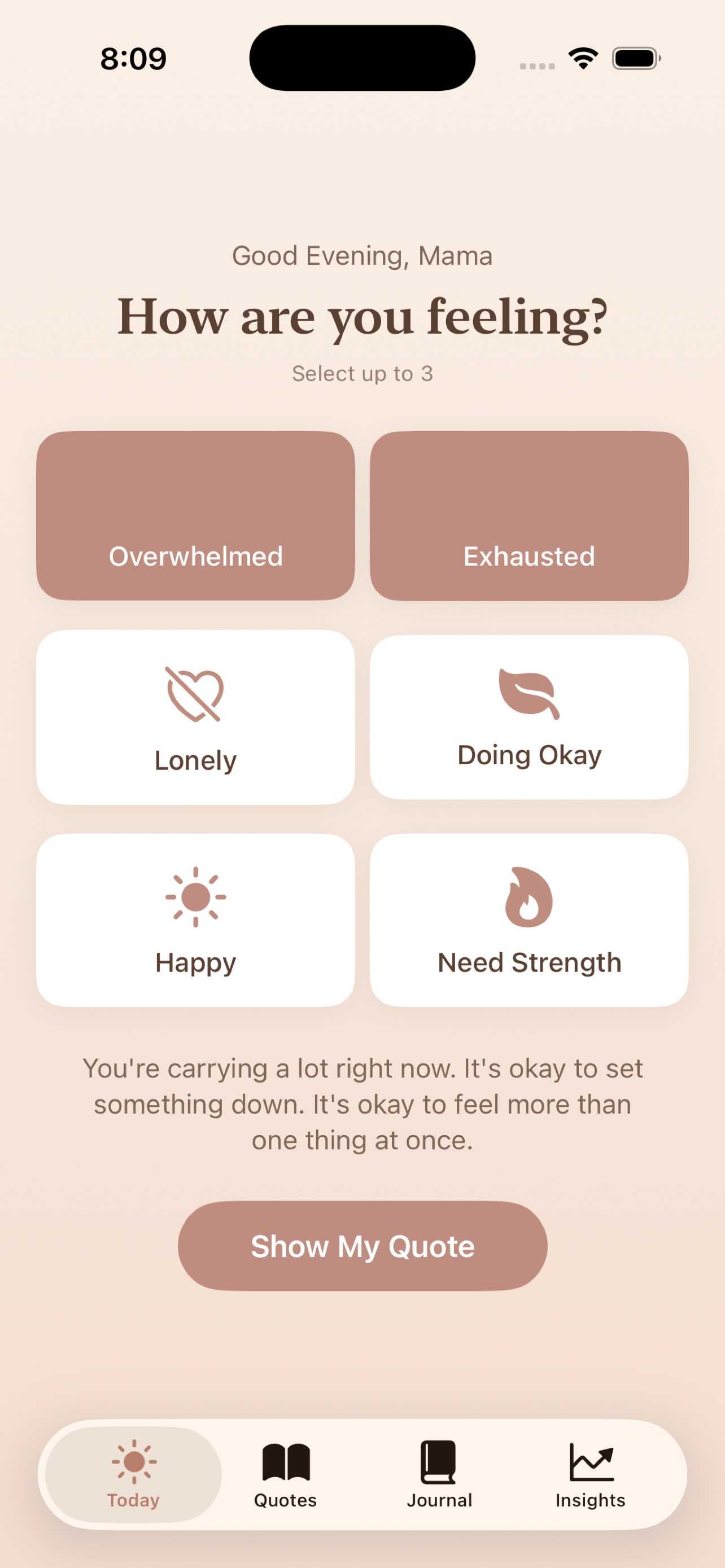
This is not a gimmick. There is a well-documented phenomenon in psychology called emotional granularity - the ability to make fine-grained distinctions between emotions. Research by Lisa Feldman Barrett has shown that people who can label their emotions with specificity are better at regulating them. The act of naming what you feel reduces its intensity. Lieberman et al. (2007) demonstrated this through fMRI studies: putting feelings into words activates the prefrontal cortex and reduces amygdala activity. In plain terms, labeling an emotion takes the edge off it.
The six moods in Momenta are not random. Three acknowledge difficulty (Overwhelmed, Exhausted, Lonely), one is neutral (Doing Okay), one is positive (Happy), and one is a request for support (Need Strength). This structure does two things. First, it normalizes hard emotions. A mother who opens an app and sees "Overwhelmed" as a first-class option feels seen. Second, it avoids the toxic positivity trap - there is no "Great!" or "Amazing!" at the top of the list. The app meets you where you are.
Mothers can also select multiple moods. You can feel exhausted and happy at the same time. That is not a contradiction - that is motherhood. The app reflects this by combining moods into a single label: "Feeling exhausted & happy." Acknowledging emotional complexity rather than forcing a single choice is itself a form of validation.
The Daily Quote: Cognitive Reframing, Not Motivation
After the mood check-in, Momenta shows a quote. Not a generic inspirational poster - a quote matched to the mood you just selected. If you checked in as "Lonely," you might see a quote from the Loneliness or Love category. If you checked in as "Overwhelmed," you see quotes about Overwhelm or Strength.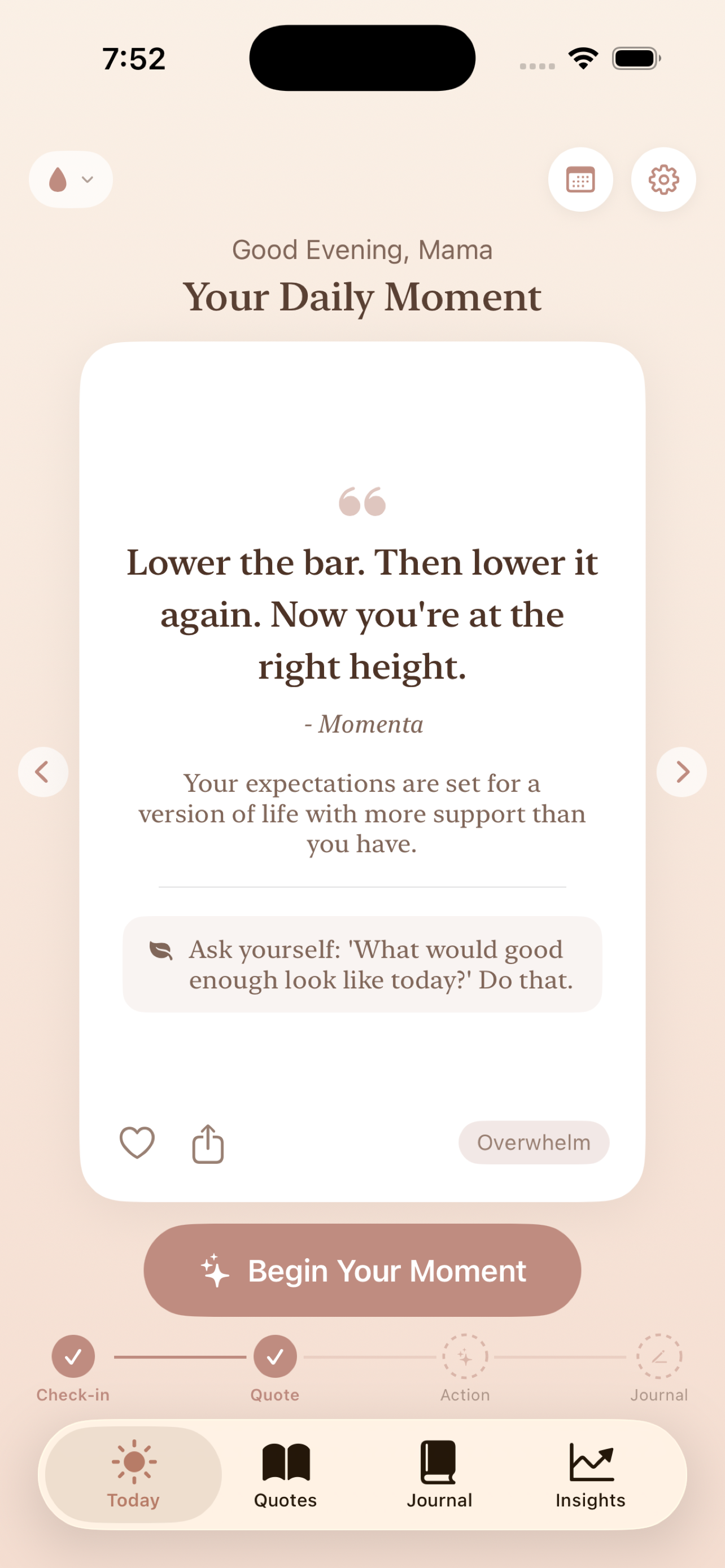
This is cognitive reframing - a core technique in CBT (Cognitive Behavioral Therapy). The idea is not to dismiss what someone is feeling, but to offer an alternative lens. "You're carrying a lot right now. It's okay to set something down." That is the app's built-in reflection for the Overwhelmed mood. It does not say "Look on the bright side." It validates the weight and then suggests one small shift.
The quote selection is not random either. Under the hood, Momenta uses a scoring algorithm that prioritizes unseen quotes, factors in how recently a quote was shown, and boosts quotes from categories the user has favorited. The top 25% of scored quotes form the selection pool. The goal is that every quote feels fresh and relevant - not repetitive, not generic.
There are 240+ quotes in the library, organized across eight categories: Exhaustion, Overwhelm, Loneliness, Strength, Self Care, Love, Joy, and Wisdom. Each maps directly to the mood system. This is not a database dump. Every quote was curated for mothers specifically.
The Suggested Action: Behavioral Activation at Micro Scale
After the quote, Momenta suggests an action. This is where the app diverges most sharply from other wellness tools. The actions are not "meditate for 20 minutes" or "go for a run." They are designed to take under five minutes, and they are tailored to the emotional state of the user.This draws on behavioral activation - a therapeutic approach that treats mood through small, achievable behaviors rather than through introspection alone. The evidence base for behavioral activation is strong, particularly for depression (Dimidjian et al., 2006). The core insight is that you do not need to feel better to act better. Small actions can break inertia, and the completion itself generates a sense of agency.
Momenta classifies suggested actions into seven types: breathing exercises, meditation, journaling prompts, social actions (like texting a friend), physical actions (like stretching or going for a walk), reflections (say something out loud to yourself), and simple timed activities. The classification happens through keyword matching against the action text, and each type routes to a purpose-built interaction.
For breathing exercises, the app runs an animated 4-4-4 breathing pattern (inhale 4 seconds, hold 4, exhale 4) with haptic feedback on each transition. This is not decorative. Slow, paced breathing activates the vagus nerve, which triggers the parasympathetic nervous system and reduces cortisol. The haptic pulses serve as a sensory anchor - they keep your attention on the breath even if your eyes are closed or a child is in the room.
For social actions ("text a friend," "call someone who gets it"), the app surfaces the device's messaging or calling interface directly. The friction between "I should reach out" and actually doing it is one of the biggest barriers for lonely mothers. Momenta eliminates one step.
Voice Journaling: Lowering the Barrier
Momenta includes a journal, but it is designed for a specific use case: a mother who has something on her mind and her hands are full. Voice-to-text journaling means she can dictate an entry while feeding a baby, folding laundry, or lying in bed. No keyboard required.Expressive writing has a deep evidence base. James Pennebaker's foundational research (1997) showed that writing about emotional experiences for as little as 15 minutes across several days improved both mental and physical health outcomes. Later research showed the mechanism: writing organizes fragmented emotional experiences into coherent narratives, which reduces the cognitive load of carrying them.
The challenge with traditional journaling apps is that they assume you will sit down and type. Mothers rarely have that luxury. Voice input changes the equation. It takes the core therapeutic mechanism (putting emotional experience into words) and removes the physical constraint.
Each journal entry in Momenta is tagged with the mood from that day's check-in. Over time, this creates a searchable emotional history - you can filter entries by mood, browse by calendar date, or search for specific words. The journal becomes a personal record of emotional patterns, not just isolated venting.
Streaks, Freeze Tokens, and Compassionate Retention
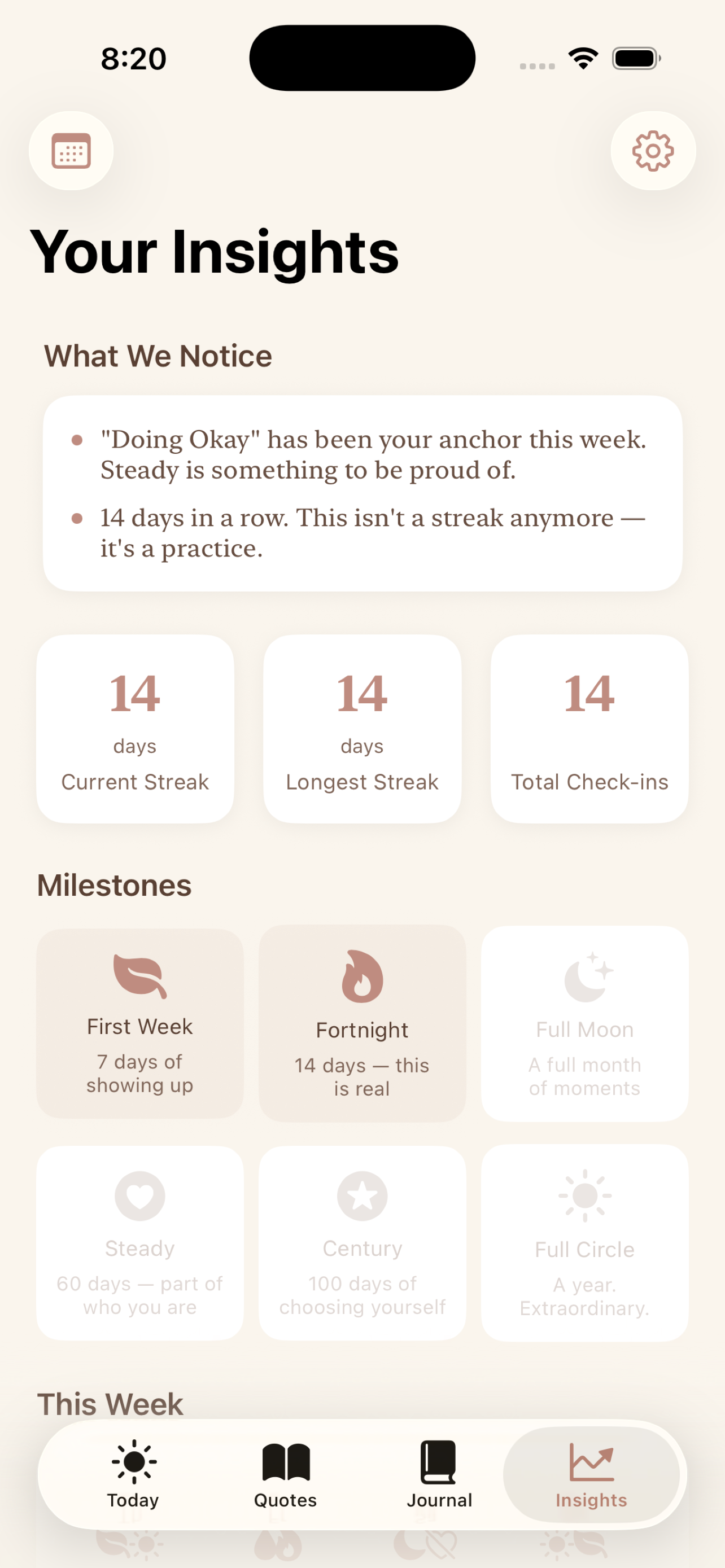
Momenta tracks streaks - consecutive days of check-ins. This is standard behavioral design. Streaks leverage loss aversion: once you have built a streak, you do not want to lose it. The daily check-in becomes easier to maintain because skipping has a visible cost.But here is where Momenta diverges from most streak-based apps. It includes freeze tokens - two per month, automatically refreshed. If you miss a day, a freeze token is consumed and your streak survives. You did not fail. Life happened.
This is a deliberate design against guilt-driven retention. Many apps use streaks as a pressure mechanism: miss a day and your progress resets to zero. For a mother who is already carrying guilt about a hundred other things, a broken streak can feel like one more failure. Freeze tokens reframe a missed day from "you failed" to "you used a resource." The distinction matters.
The milestone badges follow the same philosophy. They are earned at 7, 14, 30, 60, 100, and 365 days. The language is intentionally affirming: "7 days of showing up," "14 days - this is real," "60 days - part of who you are." They are not gamification for its own sake. They are markers of consistency framed in the language of self-recognition.
Privacy as a Prerequisite
Momenta collects zero user data. Mood entries, journal text, favorites, streaks - all of it lives on the device. Nothing is sent to a server. Nothing is stored in the cloud. If you delete the app, your data is gone.This is not a marketing bullet point. It is a design requirement driven by the nature of what the app holds. A mother journaling about postpartum anxiety, marital frustration, or feelings of inadequacy needs to know - not hope, not trust, but know - that those words are private. The moment there is any ambiguity about who might read her entries, the therapeutic value of the journal collapses. She will self-censor, and the app becomes useless.
On-device privacy is the most expensive architectural choice in the app. It means no cloud sync, no cross-device backup, no server-side analytics on usage patterns. Every feature that a typical product team would build with a backend, Momenta builds locally. The tradeoff is worth it because privacy is not a feature. It is the foundation that makes every other feature safe to use honestly.
Why Mothers, Specifically
Wellness apps are a crowded category. Calm, Headspace, Daylio, Finch - they all do some version of mood tracking, breathing, or journaling. So why build another one?Because none of them are built for mothers. They are built for "anyone," which means they are optimized for no one in particular. A meditation that asks you to "find a quiet space" is useless to someone whose house is never quiet. A journaling prompt that says "reflect on your week" assumes the user has a sense of time that extends beyond the current feeding cycle. A streak system with no grace period assumes the user controls her own schedule.
Mothers face a specific and well-documented set of mental health challenges. Perinatal mood and anxiety disorders affect approximately 1 in 5 women (Wisner et al., 2013). The transition to motherhood involves a fundamental identity shift that psychologists call matrescence - a term coined by anthropologist Dana Raphael in 1973 and recently revived by reproductive psychiatrist Alexandra Sacks. This is not a disorder. It is a developmental stage, comparable to adolescence in its scope and disorientation. And yet there are almost no tools designed to support it.
Momenta does not try to treat clinical depression or replace therapy. It occupies the space between "I'm fine" and "I need professional help" - the daily emotional maintenance that keeps a mother from sliding from one into the other. A three-second mood check-in. A quote that says "you're not alone in feeling alone." A breathing exercise while the baby naps. A journal entry dictated in the dark at 2 AM.
The Daily Ritual as Anchor
The core loop in Momenta - mood check-in, quote, suggested action, optional journal - is designed to function as a daily ritual. Rituals are psychologically distinct from habits. A habit is automatic and often unconscious. A ritual is intentional and carries meaning. Research on ritual behavior (Hobson et al., 2018) shows that rituals reduce anxiety specifically because they impose structure and predictability on chaotic environments.For a mother whose day is defined by unpredictability - nap schedules that shift, tantrums that erupt, plans that dissolve - a 90-second ritual that she controls entirely can be genuinely stabilizing. She chose to open the app. She chose to name her mood. She chose to read the quote. She chose to breathe. In a day where she has little agency, those small choices compound.
That is what Momenta is built on. Not productivity. Not optimization. Just the smallest possible daily act of showing up for yourself, designed with enough psychological rigor to actually matter.
Momenta is available on the App Store and Google Play. Learn more at hellomomenta.com.